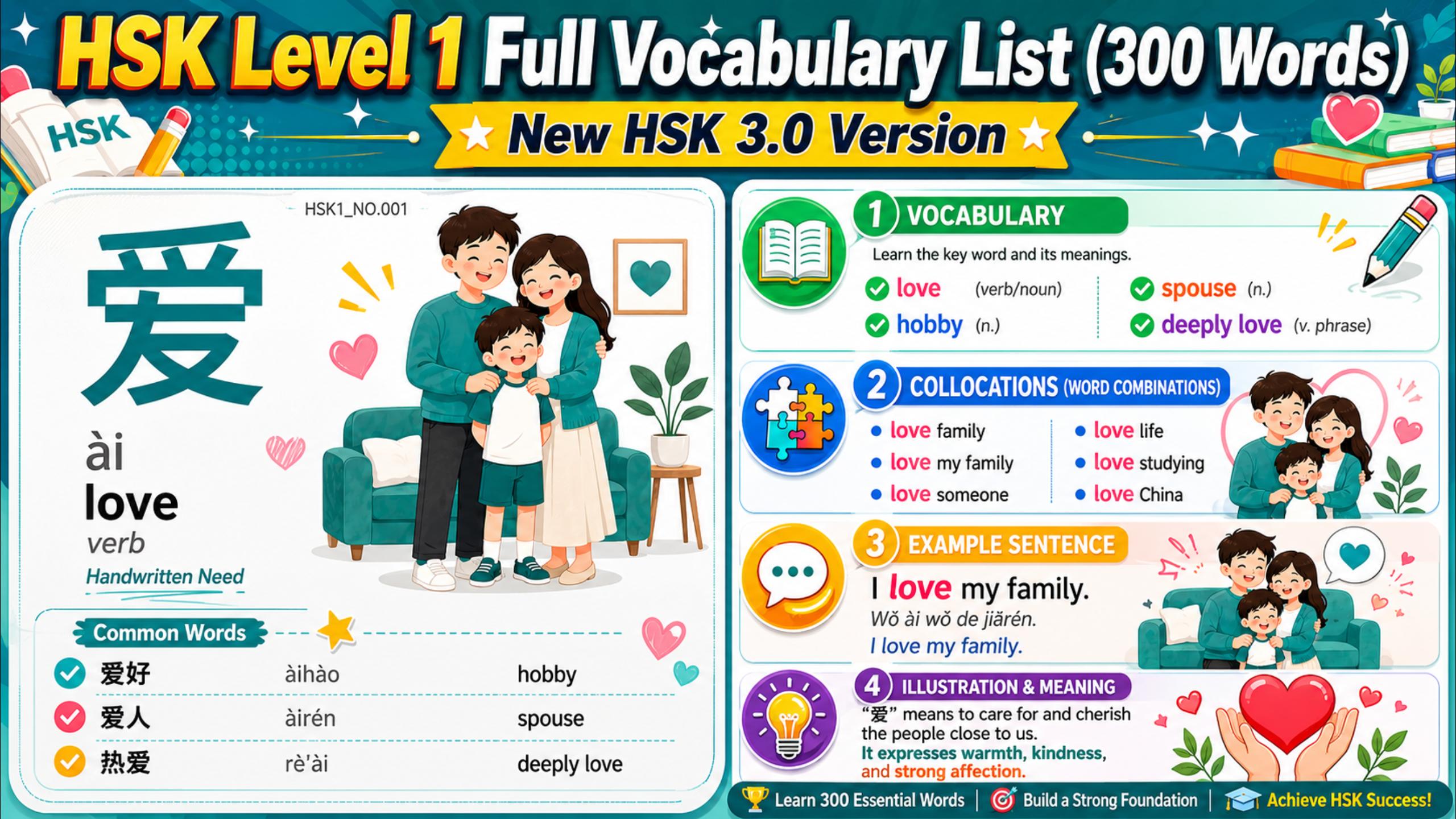
HSK 1 Full Vocabulary List (300 Words) — New HSK 3.0 is easier to remember when each word is connected to a situation, a sentence, and a sound. The material below groups useful HSK 1 vocabulary by meaning and shows how the words behave in ordinary Chinese.
For HSK 1 Full Vocabulary List (300 Words) — New HSK 3.0, work in short passes: read the Chinese aloud, check pinyin only when needed, cover the English meaning, and recall the word again the next day. Keep the words that still cause hesitation in a smaller review list.
Watch the Complete Video Lesson
This article accompanies our complete YouTube lesson covering the entire HSK Level 1 Vocabulary List (300 Words) based on the New HSK 3.0 (2026) standard.
The video includes:
- Complete pronunciation
- Native-speed reading
- Clear pinyin
- English meanings
- Easy-to-follow vocabulary review
- Beginner-friendly learning pace
YouTube Video
https://www.youtube.com/watch?v=e5Ex8wBb17o
We recommend watching the video while following this guide to maximize your learning efficiency.
What Is HSK?
HSK stands for Hanyu Shuiping Kaoshi, which translates to the Chinese Proficiency Test. It is the official standardized Chinese language examination designed for non-native Chinese speakers.
The HSK examination is recognized by:
- Universities in China
- Chinese language institutions
- International employers
- Scholarship programs
- Government organizations
Many international students take the HSK exam when applying for Chinese universities or scholarships, while professionals often use HSK certificates to demonstrate their Chinese language ability in the workplace.
The examination evaluates four core language skills:
- Listening
- Reading
- Writing
- Speaking (introduced gradually under the New HSK system)
Unlike many language tests that focus primarily on grammar, HSK emphasizes practical communication in real-life situations.
Understanding the New HSK 3.0 (2026)
The New HSK 3.0 represents the biggest update in the history of the Chinese Proficiency Test.
Earlier draft versions suggested that learners might eventually need to master more than 11,000 vocabulary words, which caused considerable concern among Chinese learners worldwide. However, the officially implemented version released for 2026 provides a much more structured and learner-friendly progression.
For beginners, the new system focuses on building practical communication skills rather than overwhelming learners with excessive vocabulary.
HSK Level 1 now contains 300 carefully selected words that are useful in daily conversations and serve as the foundation for higher levels.
The vocabulary emphasizes situations such as:
- introducing yourself
- greeting others
- asking simple questions
- telling time
- ordering food
- shopping
- talking about family
- describing daily routines
- expressing basic opinions
- understanding simple classroom instructions
Instead of memorizing isolated words, learners are encouraged to use vocabulary within meaningful contexts and complete sentences.
This approach helps students develop genuine communication abilities rather than simply passing an examination.
Why Vocabulary Is the Foundation of Chinese Learning
Many beginners spend most of their study time learning grammar rules.
While grammar is certainly important, vocabulary should always come first.
Imagine trying to build a house.
Grammar is the framework.
Vocabulary is the bricks.
Without enough bricks, you cannot build anything.
The same principle applies to Chinese.
Once you know enough words, you can begin understanding conversations, reading simple passages, recognizing sentence patterns, and expressing your own ideas.
Research in second-language acquisition consistently shows that vocabulary size is one of the strongest predictors of overall language proficiency.
For HSK Level 1, learning all 300 words allows learners to:
- understand simple conversations
- read short texts
- recognize common Chinese characters
- build basic sentences
- improve listening comprehension
- prepare for higher HSK levels
A strong vocabulary foundation also makes grammar significantly easier because grammar patterns become meaningful when learners already understand the words involved.
What Does the HSK Level 1 Vocabulary Cover?
The 300 words in HSK Level 1 are carefully selected to represent the vocabulary used most frequently in everyday life.
Instead of academic language, learners focus on practical communication.
Some of the major vocabulary categories include:
Greetings
Students learn how to greet people politely and introduce themselves.
Examples include:
- hello
- goodbye
- thank you
- you're welcome
- please
- sorry
These expressions appear constantly in daily conversations and are among the first phrases every Chinese learner should master.
Numbers
Numbers are core for shopping, transportation, dates, ages, prices, phone numbers, and time.
HSK Level 1 includes:
- 0–100
- counting
- basic measurements
- quantities
Using numbers also prepares students for more advanced grammar patterns introduced in higher HSK levels.
Family
Family-related vocabulary is another important topic.
Students learn words such as:
- father
- mother
- older brother
- younger sister
- family
These words are commonly used when introducing yourself or talking about your personal life.
Food and Drinks
One of the most enjoyable parts of learning Chinese is ordering food.
HSK Level 1 introduces useful vocabulary including:
- rice
- water
- tea
- steamed buns
- noodles
- vegetables
- fruit
These words allow learners to handle basic restaurant conversations confidently.
School
Students also learn classroom vocabulary, including:
- teacher
- student
- book
- Chinese language
- school
- class
- homework
These words are particularly useful for international students studying in China.
Time
Time expressions help learners describe daily routines.
Examples include:
- today
- tomorrow
- yesterday
- morning
- afternoon
- evening
- now
Understanding time vocabulary makes it much easier to talk about schedules and daily activities.
Transportation
Travel-related vocabulary includes:
- bus
- train
- taxi
- airport
- station
Although relatively simple, these words are extremely useful when visiting China.
Places
HSK Level 1 introduces common locations such as:
- home
- school
- restaurant
- hospital
- store
These nouns frequently appear in beginner conversations and reading passages.
Complete HSK 1 Vocabulary Table (300 Words)
Below is the full list of all 300 HSK 1 vocabulary words, complete with pinyin, English translations, parts of speech, and example sentences. Use this table as your master reference for HSK 1 exam preparation.
| # | 汉字 | Pinyin | English | Part of Speech | Example Sentence |
|---|---|---|---|---|---|
| 1 | 爱 | ài | love | verb | 我爱我的家人。 Wǒ ài wǒ de jiārén. |
| 2 | 八 | bā | eight | numeral | 现在八点了。 Xiànzài bā diǎn le. |
| 3 | 爸爸 | bàba | father, dad | noun | 我爸爸是老师。 Wǒ bàba shì lǎoshī. |
| 4 | 吧 | ba | particle (suggestion) | particle | 我们走吧。 Wǒmen zǒu ba. |
| 5 | 白天 | báitiān | daytime | noun | 我白天上班。 Wǒ báitiān shàngbān. |
| 6 | 百 | bǎi | hundred | numeral | 这本书一百元。 Zhè běn shū yì bǎi yuán. |
| 7 | 半 | bàn | half | adverb, numeral | 我吃了一半。 Wǒ chī le yí bàn. |
| 8 | 包子 | bāozi | steamed bun | noun | 我喜欢吃包子。 Wǒ xǐhuān chī bāozi. |
| 9 | 杯子 | bēizi | cup, glass | noun | 桌子上有一个杯子。 Zhuōzi shàng yǒu yí ge bēizi. |
| 10 | 本 | běn | measure word for books | measure word | 这是一本书。 Zhè shì yì běn shū. |
| 11 | 边 | biān | side, suffix for location | noun, suffix | 学校在我家旁边。 Xuéxiào zài wǒ jiā pángbiān. |
| 12 | 病 | bìng | illness, to be sick | noun, verb | 我今天生病了。 Wǒ jīntiān shēngbìng le. |
| 13 | 不 | bù | not, no | adverb | 我不是学生。 Wǒ bú shì xuéshēng. |
| 14 | 不客气 | bú kèqi | you're welcome, don't mention it | expression | A: 谢谢! B: 不客气。 A: Xièxie! B: Bú kèqi. |
| 15 | 不要 | búyào | don't, do not want | adverb | 我不要这个。 Wǒ búyào zhège. |
| 16 | 菜 | cài | vegetable, dish, cuisine | noun | 这个菜很好吃。 Zhège cài hěn hǎochī. |
| 17 | 茶 | chá | tea | noun | 我喜欢喝茶。 Wǒ xǐhuān hē chá. |
| 18 | 唱 | chàng | to sing | verb | 她会唱歌。 Tā huì chàng gē. |
| 19 | 超市 | chāoshì | supermarket | noun | 这个超市很大。 Zhège chāoshì hěn dà. |
| 20 | 车 | chē | car, vehicle | noun | 我爸爸开车。 Wǒ bàba kāi chē. |
| 21 | 吃 | chī | to eat | verb | 我喜欢吃中国菜。 Wǒ xǐhuān chī Zhōngguó cài. |
| 22 | 出租车 | chūzūchē | taxi | noun | 我坐出租车去学校。 Wǒ zuò chūzūchē qù xuéxiào. |
| 23 | 穿 | chuān | to wear, to put on | verb | 今天我穿了一件新衣服。 Jīntiān wǒ chuān le yí jiàn xīn yīfu. |
| 24 | 打电话 | dǎ diànhuà | to make a phone call | verb phrase | 我给妈妈打电话。 Wǒ gěi māma dǎ diànhuà. |
| 25 | 大 | dà | big, large | adjective | 这个苹果很大。 Zhège píngguǒ hěn dà. |
| 26 | 大家 | dàjiā | everyone, everybody | pronoun | 大家都喜欢他。 Dàjiā dōu xǐhuān tā. |
| 27 | 大学 | dàxué | university, college | noun | 我姐姐是大学生。 Wǒ jiějie shì dàxuéshēng. |
| 28 | 大学生 | dàxuéshēng | university student | noun | 我是一个大学生。 Wǒ shì yí ge dàxuéshēng. |
| 29 | 到 | dào | to arrive, to reach | verb | 我到家了。 Wǒ dào jiā le. |
| 30 | 的 | de | possessive particle | particle | 这是我的书。 Zhè shì wǒ de shū. |
| 31 | 第 | dì | prefix for ordinal numbers | prefix | 我是第一名。 Wǒ shì dì yī míng. |
| 32 | 弟弟 | dìdi | younger brother | noun | 我弟弟今年八岁。 Wǒ dìdi jīnnián bā suì. |
| 33 | 点 | diǎn | o'clock, point, dot | measure word, noun | 现在几点? Xiànzài jǐ diǎn? |
| 34 | 店 | diàn | shop, store | noun | 这个商店很大。 Zhège shāngdiàn hěn dà. |
| 35 | 电话 | diànhuà | telephone, phone | noun | 我的电话在桌子上。 Wǒ de diànhuà zài zhuōzi shàng. |
| 36 | 电脑 | diànnǎo | computer | noun | 我用电脑学习汉语。 Wǒ yòng diànnǎo xuéxí Hànyǔ. |
| 37 | 电视 | diànshì | television, TV | noun | 我晚上看电视。 Wǒ wǎnshang kàn diànshì. |
| 38 | 电影 | diànyǐng | movie, film | noun | 我喜欢看电影。 Wǒ xǐhuān kàn diànyǐng. |
| 39 | 电影院 | diànyǐngyuàn | cinema, movie theater | noun | 我和朋友去电影院。 Wǒ hé péngyou qù diànyǐngyuàn. |
| 40 | 东西 | dōngxi | thing, stuff | noun | 我去超市买东西。 Wǒ qù chāoshì mǎi dōngxi. |
| 41 | 都 | dōu | all, both | adverb | 我们都是学生。 Wǒmen dōu shì xuéshēng. |
| 42 | 读 | dú | to read | verb | 我喜欢读书。 Wǒ xǐhuān dú shū. |
| 43 | 读书 | dúshū | to read, to study | verb | 我在学校读书。 Wǒ zài xuéxiào dúshū. |
| 44 | 对 | duì | correct, right; to, towards | adjective, preposition, verb | 你说得对。 Nǐ shuō de duì. |
| 45 | 对不起 | duìbuqǐ | sorry, I'm sorry | verb | 对不起,我来晚了。 Duìbuqǐ, wǒ lái wǎn le. |
| 46 | 多 | duō | many, much, how (degree) | adjective, adverb, pronoun | 这里有很多人。 Zhèlǐ yǒu hěn duō rén. |
| 47 | 多少 | duōshao | how many, how much | pronoun | 这个多少钱? Zhège duōshao qián? |
| 48 | 儿子 | érzi | son | noun | 他有一个儿子。 Tā yǒu yí ge érzi. |
| 49 | 二 | èr | two | numeral | 我有两个弟弟。 Wǒ yǒu liǎng ge dìdi. |
| 50 | 饭 | fàn | meal, cooked rice | noun | 我还没有吃饭。 Wǒ hái méiyǒu chī fàn. |
| 51 | 饭店 | fàndiàn | restaurant | noun | 我们在饭店吃饭。 Wǒmen zài fàndiàn chī fàn. |
| 52 | 房间 | fángjiān | room | noun | 我的房间很大。 Wǒ de fángjiān hěn dà. |
| 53 | 非常 | fēicháng | very, extremely | adverb | 我非常喜欢中国。 Wǒ fēicháng xǐhuān Zhōngguó. |
| 54 | 飞机 | fēijī | airplane | noun | 我坐飞机去北京。 Wǒ zuò fēijī qù Běijīng. |
| 55 | 分 | fēn | minute, cent, to divide | measure word, noun, verb | 现在八点十分。 Xiànzài bā diǎn shí fēn. |
| 56 | 分钟 | fēnzhōng | minute (measure word) | measure word | 等我十分钟。 Děng wǒ shí fēnzhōng. |
| 57 | 高兴 | gāoxìng | happy, glad | adjective | 今天我很高兴。 Jīntiān wǒ hěn gāoxìng. |
| 58 | 歌 | gē | song | noun | 这首歌很好听。 Zhè shǒu gē hěn hǎotīng. |
| 59 | 哥哥 | gēge | older brother | noun | 我哥哥是医生。 Wǒ gēge shì yīshēng. |
| 60 | 个 | gè | general measure word | measure word | 我有一个苹果。 Wǒ yǒu yí ge píngguǒ. |
| 61 | 给 | gěi | to give, for | preposition, verb | 请给我一杯水。 Qǐng gěi wǒ yì bēi shuǐ. |
| 62 | 公司 | gōngsī | company, corporation | noun | 我在一家公司工作。 Wǒ zài yì jiā gōngsī gōngzuò. |
| 63 | 工作 | gōngzuò | to work, job | noun, verb | 我爸爸工作很忙。 Wǒ bàba gōngzuò hěn máng. |
| 64 | 狗 | gǒu | dog | noun | 我有一条小狗。 Wǒ yǒu yì tiáo xiǎo gǒu. |
| 65 | 贵 | guì | expensive, costly | adjective | 这件衣服很贵。 Zhè jiàn yīfu hěn guì. |
| 66 | 国 | guó | country, nation | noun | 中国很好。 Zhōngguó hěn hǎo. |
| 67 | 还 | hái | still, also, yet | adverb | 我还没吃饭。 Wǒ hái méi chī fàn. |
| 68 | 孩子 | háizi | child, children | noun | 孩子们在玩。 Háizimen zài wán. |
| 69 | 汉语 | Hànyǔ | Chinese language | noun | 我在学汉语。 Wǒ zài xué Hànyǔ. |
| 70 | 汉字 | Hànzì | Chinese character | noun | 这个汉字怎么写? Zhège Hànzì zěnme xiě? |
| 71 | 好 | hǎo | good, well | adjective, adverb, verb | 今天天气很好。 Jīntiān tiānqì hěn hǎo. |
| 72 | 好吃 | hǎochī | delicious, tasty | adjective | 这个菜很好吃。 Zhège cài hěn hǎochī. |
| 73 | 好看 | hǎokàn | good-looking, nice | adjective | 这件衣服很好看。 Zhè jiàn yīfu hěn hǎokàn. |
| 74 | 好听 | hǎotīng | pleasant to listen to | adjective | 这首歌很好听。 Zhè shǒu gē hěn hǎotīng. |
| 75 | 好玩 | hǎowán | fun, amusing | adjective | 这个游戏很好玩。 Zhège yóuxì hěn hǎowán. |
| 76 | 号 | hào | number, day of month | measure word, noun | 今天六月十四号。 Jīntiān liù yuè shísì hào. |
| 77 | 喝 | hē | to drink | verb | 我想喝水。 Wǒ xiǎng hē shuǐ. |
| 78 | 和 | hé | and, with | conjunction, preposition | 我和他是朋友。 Wǒ hé tā shì péngyou. |
| 79 | 很 | hěn | very | adverb | 他很高兴。 Tā hěn gāoxìng. |
| 80 | 后 | hòu | after, behind | noun | 下课以后我去找你。 Xiàkè yǐhòu wǒ qù zhǎo nǐ. |
| 81 | 回 | huí | to return, time (occurrence) | measure word, verb | 我明天回家。 Wǒ míngtiān huí jiā. |
| 82 | 会 | huì | can, to know how to | verb | 我会说汉语。 Wǒ huì shuō Hànyǔ. |
| 83 | 火车 | huǒchē | train | noun | 我坐火车去上海。 Wǒ zuò huǒchē qù Shànghǎi. |
| 84 | 鸡蛋 | jīdàn | egg (chicken egg) | noun | 我早上吃了一个鸡蛋。 Wǒ zǎoshang chī le yí ge jīdàn. |
| 85 | 几 | jǐ | how many, several | numeral, pronoun | 你有几个弟弟? Nǐ yǒu jǐ ge dìdi? |
| 86 | 家 | jiā | home, family, measure word for businesses | measure word, noun, suffix | 我家有三个人。 Wǒ jiā yǒu sān ge rén. |
| 87 | 家人 | jiārén | family members | noun | 我爱我的家人。 Wǒ ài wǒ de jiārén. |
| 88 | 见 | jiàn | to see, to meet | verb | 我明天去见你。 Wǒ míngtiān qù jiàn nǐ. |
| 89 | 件 | jiàn | measure word for clothes/matters | measure word | 我买了一件新衣服。 Wǒ mǎi le yí jiàn xīn yīfu. |
| 90 | 饺子 | jiǎozi | dumpling (jiaozi) | noun | 我爱吃饺子。 Wǒ ài chī jiǎozi. |
| 91 | 叫 | jiào | to call, to be called | preposition, verb | 我的名字叫小明。 Wǒ de míngzi jiào Xiǎomíng. |
| 92 | 姐姐 | jiějie | older sister | noun | 我姐姐是大学生。 Wǒ jiějie shì dàxuéshēng. |
| 93 | 今年 | jīnnián | this year | noun | 今年我八岁。 Jīnnián wǒ bā suì. |
| 94 | 今天 | jīntiān | today | noun | 今天天气很好。 Jīntiān tiānqì hěn hǎo. |
| 95 | 九 | jiǔ | nine | numeral | 现在九点了。 Xiànzài jiǔ diǎn le. |
| 96 | 觉得 | juéde | to feel, to think | verb | 我觉得这个菜很好吃。 Wǒ juéde zhège cài hěn hǎochī. |
| 97 | 开 | kāi | to open, to drive | verb | 请开门。 Qǐng kāi mén. |
| 98 | 开车 | kāichē | to drive a car | verb | 我爸爸开车去上班。 Wǒ bàba kāichē qù shàngbān. |
| 99 | 看 | kàn | to look, to watch, to read | verb | 我喜欢看书。 Wǒ xǐhuān kàn shū. |
| 100 | 看病 | kànbìng | to see a doctor | verb | 我今天去看病。 Wǒ jīntiān qù kànbìng. |
| 101 | 看见 | kànjiàn | to see (resultative) | verb | 我看见了一只猫。 Wǒ kànjiàn le yì zhī māo. |
| 102 | 可以 | kěyǐ | can, may, okay | adjective, verb | 我可以坐在这里吗? Wǒ kěyǐ zuò zài zhèlǐ ma? |
| 103 | 课 | kè | class, lesson | noun | 我上午有课。 Wǒ shàngwǔ yǒu kè. |
| 104 | 口 | kǒu | mouth, measure word for family members | measure word, noun | 我家有三口人。 Wǒ jiā yǒu sān kǒu rén. |
| 105 | 块 | kuài | measure word for money (yuan), piece | measure word | 这个五块钱。 Zhège wǔ kuài qián. |
| 106 | 来 | lái | to come | verb | 请进来。 Qǐng jìnlái. |
| 107 | 老师 | lǎoshī | teacher | noun | 我们的老师很好。 Wǒmen de lǎoshī hěn hǎo. |
| 108 | 了 | le | particle (completed action / change of state) | particle | 我吃了饭。 Wǒ chī le fàn. |
| 109 | 冷 | lěng | cold | adjective | 今天很冷。 Jīntiān hěn lěng. |
| 110 | 里 | lǐ | inside, in | noun | 他在家里。 Tā zài jiā lǐ. |
| 111 | 两 | liǎng | two (before measure words) | numeral | 我有两个苹果。 Wǒ yǒu liǎng ge píngguǒ. |
| 112 | 零 | líng | zero | numeral | 今天零下五度。 Jīntiān líng xià wǔ dù. |
| 113 | 六 | liù | six | numeral | 现在六点了。 Xiànzài liù diǎn le. |
| 114 | 妈妈 | māma | mother, mom | noun | 我妈妈是医生。 Wǒ māma shì yīshēng. |
| 115 | 吗 | ma | question particle | particle | 你还好吗? Nǐ hái hǎo ma? |
| 116 | 买 | mǎi | to buy | verb | 我去商店买东西。 Wǒ qù shāngdiàn mǎi dōngxi. |
| 117 | 卖 | mài | to sell | verb | 这个商店卖水果。 Zhège shāngdiàn mài shuǐguǒ. |
| 118 | 忙 | máng | busy | adjective, verb | 我爸爸工作很忙。 Wǒ bàba gōngzuò hěn máng. |
| 119 | 猫 | māo | cat | noun | 我有一只猫。 Wǒ yǒu yì zhī māo. |
| 120 | 没关系 | méi guānxi | it doesn't matter, no problem | expression | 没关系,不用担心。 Méi guānxi, búyòng dānxīn. |
| 121 | 没事 | méishì | it's nothing, no problem | expression | 没事,不用担心。 Méishì, búyòng dānxīn. |
| 122 | 没有 | méiyǒu | don't have, haven't | adverb, verb | 我没有书。 Wǒ méiyǒu shū. |
| 123 | 妹妹 | mèimei | younger sister | noun | 我妹妹今年五岁。 Wǒ mèimei jīnnián wǔ suì. |
| 124 | 们 | men | plural suffix for people | suffix | 我们是好朋友。 Wǒmen shì hǎo péngyou. |
| 125 | 米饭 | mǐfàn | cooked rice | noun | 我中午吃米饭。 Wǒ zhōngwǔ chī mǐfàn. |
| 126 | 面包 | miànbāo | bread | noun | 我早上吃面包。 Wǒ zǎoshang chī miànbāo. |
| 127 | 面条 | miàntiáo | noodles | noun | 我爱吃面条。 Wǒ ài chī miàntiáo. |
| 128 | 明年 | míngnián | next year | noun | 明年我上大学。 Míngnián wǒ shàng dàxué. |
| 129 | 明天 | míngtiān | tomorrow | noun | 明天我去北京。 Míngtiān wǒ qù Běijīng. |
| 130 | 名字 | míngzi | name | noun | 你的名字叫什么? Nǐ de míngzi jiào shénme? |
| 131 | 哪 | nǎ | which, where | pronoun | 你是哪国人? Nǐ shì nǎ guó rén? |
| 132 | 哪个 | nǎge | which one | pronoun | 哪个是你的? Nǎge shì nǐ de? |
| 133 | 哪里 | nǎlǐ | where | pronoun | 你家在哪里? Nǐ jiā zài nǎlǐ? |
| 134 | 哪儿 | nǎ ér | where (colloquial) | pronoun | 你去哪儿? Nǐ qù nǎr? |
| 135 | 哪些 | nǎxiē | which ones (plural) | pronoun | 哪些是你的? Nǎxiē shì nǐ de? |
| 136 | 那 | nà | that, then | conjunction, pronoun | 那是我的书。 Nà shì wǒ de shū. |
| 137 | 那边 | nàbiān | over there | pronoun | 学校在那边。 Xuéxiào zài nàbiān. |
| 138 | 那个 | nàge | that one | pronoun | 那个人是我的老师。 Nàge rén shì wǒ de lǎoshī. |
| 139 | 那里 | nàlǐ | there | pronoun | 那里有很多人。 Nàlǐ yǒu hěn duō rén. |
| 140 | 那儿 | nà ér | there (colloquial) | pronoun | 我的书在那儿。 Wǒ de shū zài nà ér. |
| 141 | 那些 | nàxiē | those | pronoun | 那些是我的朋友。 Nàxiē shì wǒ de péngyou. |
| 142 | 男 | nán | male, man | adjective | 那个男人是我的老师。 Nàge nánrén shì wǒ de lǎoshī. |
| 143 | 男朋友 | nánpéngyou | boyfriend | noun | 我男朋友是医生。 Wǒ nánpéngyou shì yīshēng. |
| 144 | 呢 | ne | particle (follow-up question) | particle | 我很好,你呢? Wǒ hěn hǎo, nǐ ne? |
| 145 | 能 | néng | can, to be able to | verb | 我能说汉语。 Wǒ néng shuō Hànyǔ. |
| 146 | 你 | nǐ | you (singular) | pronoun | 你是学生吗? Nǐ shì xuéshēng ma? |
| 147 | 你好 | nǐ hǎo | hello | expression | 你好,很高兴认识你。 Nǐ hǎo, hěn gāoxìng rènshi nǐ. |
| 148 | 你们 | nǐmen | you (plural) | pronoun | 你们是学生吗? Nǐmen shì xuéshēng ma? |
| 149 | 年 | nián | year | measure word, noun | 一年有十二个月。 Yì nián yǒu shí'èr ge yuè. |
| 150 | 您 | nín | you (polite form) | pronoun | 您好,请问您贵姓? Nín hǎo, qǐngwèn nín guì xìng? |
| 151 | 牛奶 | niúnǎi | milk | noun | 我早上喝牛奶。 Wǒ zǎoshang hē niúnǎi. |
| 152 | 女 | nǚ | female, woman | adjective | 那个女人是我的妈妈。 Nàge nǚrén shì wǒ de māma. |
| 153 | 女儿 | nǚ’ér | daughter | noun | 她有一个女儿。 Tā yǒu yí ge nǚ'ér. |
| 154 | 女朋友 | nǚpéngyou | girlfriend | noun | 我女朋友是老师。 Wǒ nǚpéngyou shì lǎoshī. |
| 155 | 女士 | nǚshì | lady, Ms., ma'am | noun | 这位女士是我的老师。 Zhè wèi nǚshì shì wǒ de lǎoshī. |
| 156 | 朋友 | péngyou | friend | noun | 他是我的好朋友。 Tā shì wǒ de hǎo péngyou. |
| 157 | 便宜 | piányi | cheap, inexpensive | adjective | 这个苹果很便宜。 Zhège píngguǒ hěn piányi. |
| 158 | 漂亮 | piàoliang | beautiful, pretty | adjective | 这件衣服很漂亮。 Zhè jiàn yīfu hěn piàoliang. |
| 159 | 苹果 | píngguǒ | apple | noun | 我喜欢吃苹果。 Wǒ xǐhuān chī píngguǒ. |
| 160 | 七 | qī | seven | numeral | 现在七点了。 Xiànzài qī diǎn le. |
| 161 | 起床 | qǐchuáng | to get up (from bed) | verb | 我早上六点起床。 Wǒ zǎoshang liù diǎn qǐchuáng. |
| 162 | 千 | qiān | thousand | numeral | 这本书一千元。 Zhè běn shū yì qiān yuán. |
| 163 | 前 | qián | before, in front, previous | noun | 学校在我家前面。 Xuéxiào zài wǒ jiā qiánmiàn. |
| 164 | 钱 | qián | money | noun | 我没有钱。 Wǒ méiyǒu qián. |
| 165 | 请 | qǐng | please, to invite | verb | 请坐。 Qǐng zuò. |
| 166 | 请问 | qǐngwèn | may I ask, excuse me | verb | 请问,超市在哪儿? Qǐngwèn, chāoshì zài nǎr? |
| 167 | 去 | qù | to go | verb | 我去学校。 Wǒ qù xuéxiào. |
| 168 | 去年 | qùnián | last year | noun | 去年我在中国。 Qùnián wǒ zài Zhōngguó. |
| 169 | 热 | rè | hot | adjective | 今天很热。 Jīntiān hěn rè. |
| 170 | 人 | rén | person, people | noun | 那个人是我的朋友。 Nàge rén shì wǒ de péngyou. |
| 171 | 认识 | rènshi | to know, to recognize | verb | 认识你很高兴。 Rènshi nǐ hěn gāoxìng. |
| 172 | 日 | rì | sun, day | measure word, noun | 今天是我的生日。 Jīntiān shì wǒ de shēngrì. |
| 173 | 三 | sān | three | numeral | 我家有三口人。 Wǒ jiā yǒu sān kǒu rén. |
| 174 | 商店 | shāngdiàn | shop, store | noun | 我去商店买东西。 Wǒ qù shāngdiàn mǎi dōngxi. |
| 175 | 上 | shàng | up, above, to go to | noun, verb | 书在桌子上。 Shū zài zhuōzi shàng. |
| 176 | 上班 | shàngbān | to go to work | verb | 我爸爸去上班了。 Wǒ bàba qù shàngbān le. |
| 177 | 上课 | shàngkè | to attend class | verb | 我上午上课。 Wǒ shàngwǔ shàngkè. |
| 178 | 上午 | shàngwǔ | morning, before noon | noun | 我上午九点上课。 Wǒ shàngwǔ jiǔ diǎn shàngkè. |
| 179 | 上学 | shàngxué | to go to school | verb | 我弟弟今年上学了。 Wǒ dìdi jīnnián shàngxué le. |
| 180 | 少 | shǎo | few, little, less | adjective, verb | 今天人很少。 Jīntiān rén hěn shǎo. |
| 181 | 谁 | shéi/shuí | who | pronoun | 那个人是谁? Nàge rén shì shéi? |
| 182 | 什么 | shénme | what | pronoun | 你想吃什么? Nǐ xiǎng chī shénme? |
| 183 | 生病 | shēngbìng | to get sick, to fall ill | verb | 他生病了,今天没来上学。 Tā shēngbìng le, jīntiān méi lái shàngxué. |
| 184 | 十 | shí | ten | numeral | 现在十点了。 Xiànzài shí diǎn le. |
| 185 | 时候 | shíhou | time, moment | noun | 你什么时候回来? Nǐ shénme shíhou huílái? |
| 186 | 时间 | shíjiān | time (duration) | noun | 我没有时间。 Wǒ méiyǒu shíjiān. |
| 187 | 事 | shì | matter, thing, affair | noun | 今天你有什么事? Jīntiān nǐ yǒu shénme shì? |
| 188 | 是 | shì | to be, is, am, are | verb | 我是中国人。 Wǒ shì Zhōngguó rén. |
| 189 | 手机 | shǒujī | mobile phone | noun | 我买了一个新手机。 Wǒ mǎi le yí ge xīn shǒujī. |
| 190 | 书 | shū | book | noun | 这是一本好书。 Zhè shì yì běn hǎo shū. |
| 191 | 书店 | shūdiàn | bookstore | noun | 我去书店买书。 Wǒ qù shūdiàn mǎi shū. |
| 192 | 水 | shuǐ | water | noun | 我想喝水。 Wǒ xiǎng hē shuǐ. |
| 193 | 水果 | shuǐguǒ | fruit | noun | 我喜欢吃水果。 Wǒ xǐhuān chī shuǐguǒ. |
| 194 | 睡 | shuì | to sleep | verb | 我十点睡。 Wǒ shí diǎn shuì. |
| 195 | 睡觉 | shuìjiào | to sleep, to go to bed | verb | 我晚上十点睡觉。 Wǒ wǎnshang shí diǎn shuìjiào. |
| 196 | 说 | shuō | to speak, to say | verb | 我会说汉语。 Wǒ huì shuō Hànyǔ. |
| 197 | 说话 | shuōhuà | to talk, to speak | verb | 爸爸妈妈在说话。 Bàba māma zài shuōhuà. |
| 198 | 四 | sì | four | numeral | 我家有四口人。 Wǒ jiā yǒu sì kǒu rén. |
| 199 | 岁 | suì | year (of age) | measure word | 你今年几岁了? Nǐ jīnnián jǐ suì le? |
| 200 | 他 | tā | he, him | pronoun | 他是我的朋友。 Tā shì wǒ de péngyou. |
| 201 | 它 | tā | it (for animals/things) | pronoun | 它是一只小猫。 Tā shì yì zhī xiǎo māo. |
| 202 | 她 | tā | she, her | pronoun | 她是我的姐姐。 Tā shì wǒ de jiějie. |
| 203 | 他们 | tāmen | they, them (mixed or male) | pronoun | 他们都是我的朋友。 Tāmen dōu shì wǒ de péngyou. |
| 204 | 它们 | tāmen | they, them (animals/things) | pronoun | 它们是小猫。 Tāmen shì xiǎo māo. |
| 205 | 她们 | tāmen | they, them (all female) | pronoun | 她们是我的同学。 Tāmen shì wǒ de tóngxué. |
| 206 | 太 | tài | too, excessively | adverb | 这件衣服太贵了。 Zhè jiàn yīfu tài guì le. |
| 207 | 天 | tiān | day, sky, heaven | measure word, noun | 今天天气很好。 Jīntiān tiānqì hěn hǎo. |
| 208 | 天气 | tiānqì | weather | noun | 今天天气怎么样? Jīntiān tiānqì zěnmeyàng? |
| 209 | 听 | tīng | to listen | verb | 我喜欢听歌。 Wǒ xǐhuān tīng gē. |
| 210 | 听见 | tīngjiàn | to hear | verb | 我听不见你说话。 Wǒ tīng bu jiàn nǐ shuōhuà. |
| 211 | 同学 | tóngxué | classmate | noun | 他是我的同学。 Tā shì wǒ de tóngxué. |
| 212 | 外 | wài | outside, foreign | noun | 外面很冷。 Wàimiàn hěn lěng. |
| 213 | 外边 | wàibian | outside | noun | 我们去外边玩吧。 Wǒmen qù wàibian wán ba. |
| 214 | 玩 | wán | to play, to have fun | verb | 我和朋友出去玩。 Wǒ hé péngyou chūqù wán. |
| 215 | 晚 | wǎn | late, evening | adjective, noun | 现在太晚了。 Xiànzài tài wǎn le. |
| 216 | 晚饭 | wǎnfàn | dinner, supper | noun | 我晚上六点吃晚饭。 Wǒ wǎnshang liù diǎn chī wǎnfàn. |
| 217 | 晚上 | wǎnshang | evening, night | noun | 我晚上看电视。 Wǒ wǎnshang kàn diànshì. |
| 218 | 喂 | wèi | hello (on the phone) | interjection | 喂,请问你是谁? Wèi, qǐngwèn nǐ shì shéi? |
| 219 | 问 | wèn | to ask | verb | 我能问你一个问题吗? Wǒ néng wèn nǐ yí ge wèntí ma? |
| 220 | 问题 | wèntí | question, problem | noun | 你有什么问题吗? Nǐ yǒu shénme wèntí ma? |
| 221 | 我 | wǒ | I, me | pronoun | 我是学生。 Wǒ shì xuéshēng. |
| 222 | 我们 | wǒmen | we, us | pronoun | 我们是好朋友。 Wǒmen shì hǎo péngyou. |
| 223 | 五 | wǔ | five | numeral | 现在五点了。 Xiànzài wǔ diǎn le. |
| 224 | 午饭 | wǔfàn | lunch | noun | 我中午十二点吃午饭。 Wǒ zhōngwǔ shí'èr diǎn chī wǔfàn. |
| 225 | 喜欢 | xǐhuān | to like, to be fond of | verb | 我喜欢看电影。 Wǒ xǐhuān kàn diànyǐng. |
| 226 | 下 | xià | down, below, next, to get off | measure word, noun, verb | 猫在桌子下面。 Māo zài zhuōzi xiàmiàn. |
| 227 | 下雨 | xià yǔ | to rain | verb phrase | 今天下雨了。 Jīntiān xià yǔ le. |
| 228 | 下班 | xiàbān | to get off work | verb | 我爸爸五点下班。 Wǒ bàba wǔ diǎn xiàbān. |
| 229 | 下课 | xiàkè | to finish class | verb | 下课以后我去吃饭。 Xiàkè yǐhòu wǒ qù chī fàn. |
| 230 | 下午 | xiàwǔ | afternoon | noun | 我下午去看朋友。 Wǒ xiàwǔ qù kàn péngyou. |
| 231 | 先生 | xiānsheng | Mister (Mr.), gentleman, husband | noun | 王先生是我的老师。 Wáng xiānsheng shì wǒ de lǎoshī. |
| 232 | 现在 | xiànzài | now | noun | 现在我有时间。 Xiànzài wǒ yǒu shíjiān. |
| 233 | 想 | xiǎng | to think, to want, to miss | verb | 我想去中国。 Wǒ xiǎng qù Zhōngguó. |
| 234 | 小 | xiǎo | small, little | adjective, prefix | 这个房间很小。 Zhège fángjiān hěn xiǎo. |
| 235 | 小朋友 | xiǎopéngyǒu | child, kid | noun | 小朋友们在学校玩。 Xiǎopéngyǒumen zài xuéxiào wán. |
| 236 | 小时 | xiǎoshí | hour | noun | 我学了两个小时汉语。 Wǒ xué le liǎng ge xiǎoshí Hànyǔ. |
| 237 | 小学 | xiǎoxué | elementary school | noun | 我弟弟上小学了。 Wǒ dìdi shàng xiǎoxué le. |
| 238 | 小学生 | xiǎoxuéshēng | elementary school student | noun | 我是一个小学生。 Wǒ shì yí ge xiǎoxuéshēng. |
| 239 | 些 | xiē | some, a few | measure word | 我有一些书。 Wǒ yǒu yìxiē shū. |
| 240 | 写 | xiě | to write | verb | 我会写我的名字。 Wǒ huì xiě wǒ de míngzi. |
| 241 | 谢谢 | xièxie | to thank, thanks | verb | 谢谢你! Xièxie nǐ! |
| 242 | 新 | xīn | new | adjective | 我买了一件新衣服。 Wǒ mǎi le yí jiàn xīn yīfu. |
| 243 | 星期 | xīngqī | week | noun | 一个星期有七天。 Yí ge xīngqī yǒu qī tiān. |
| 244 | 星期日 | xīngqīrì | Sunday | noun | 星期日我不上班。 Xīngqīrì wǒ bú shàngbān. |
| 245 | 星期天 | xīngqītiān | Sunday (colloquial) | noun | 星期天我去看奶奶。 Xīngqītiān wǒ qù kàn nǎinai. |
| 246 | 休息 | xiūxi | to rest, to take a break | verb | 你累了,休息一下吧。 Nǐ lèi le, xiūxi yíxià ba. |
| 247 | 学 | xué | to learn, to study | verb | 我想学汉语。 Wǒ xiǎng xué Hànyǔ. |
| 248 | 学生 | xuéshēng | student | noun | 我是学生。 Wǒ shì xuéshēng. |
| 249 | 学习 | xuéxí | to study, to learn | verb | 我每天学习汉语。 Wǒ měitiān xuéxí Hànyǔ. |
| 250 | 学校 | xuéxiào | school | noun | 我走路去学校。 Wǒ zǒulù qù xuéxiào. |
| 251 | 雪 | xuě | snow | noun | 今天下雪了。 Jīntiān xià xuě le. |
| 252 | 要 | yào | to want, to need, to be going to | verb | 我要一杯水。 Wǒ yào yì bēi shuǐ. |
| 253 | 也 | yě | also, too | adverb | 我也是学生。 Wǒ yě shì xuéshēng. |
| 254 | 一 | yī | one | numeral | 我有一个妹妹。 Wǒ yǒu yí ge mèimei. |
| 255 | 衣服 | yīfu | clothing, clothes | noun | 这件衣服很好看。 Zhè jiàn yīfu hěn hǎokàn. |
| 256 | 医生 | yīshēng | doctor | noun | 我妈妈是医生。 Wǒ māma shì yīshēng. |
| 257 | 医院 | yīyuàn | hospital | noun | 我去医院看医生。 Wǒ qù yīyuàn kàn yīshēng. |
| 258 | 一半 | yíbàn | one half | numeral | 我们一人吃一半。 Wǒmen yì rén chī yíbàn. |
| 259 | 一下 | yíxià | briefly, a bit, a while | adverb, numeral-measure compound | 请等一下。 Qǐng děng yíxià. |
| 260 | 椅子 | yǐzi | chair | noun | 请坐在椅子上。 Qǐng zuò zài yǐzi shàng. |
| 261 | 一点 | yìdiǎn | a little, a bit | numeral-measure compound | 我只会说一点汉语。 Wǒ zhǐ huì shuō yìdiǎn Hànyǔ. |
| 262 | 一些 | yìxiē | some, a few | numeral-measure compound | 我买了一些水果。 Wǒ mǎi le yìxiē shuǐguǒ. |
| 263 | 有 | yǒu | to have, there is/are | verb | 我有一只猫。 Wǒ yǒu yì zhī māo. |
| 264 | 有的 | yǒude | some (of) | pronoun | 有的人喜欢猫,有的人喜欢狗。 Yǒude rén xǐhuān māo, yǒude rén xǐhuān gǒu. |
| 265 | 有点儿 | yǒudiǎnr | a little bit, somewhat | adverb | 今天有点儿冷。 Jīntiān yǒudiǎnr lěng. |
| 266 | 有些 | yǒuxiē | some, somewhat | adverb, pronoun | 有些人喜欢早起。 Yǒuxiē rén xǐhuān zǎo qǐ. |
| 267 | 雨 | yǔ | rain | noun | 今天下雨了。 Jīntiān xià yǔ le. |
| 268 | 元 | yuán | yuan (Chinese currency unit) | measure word | 这个是五元。 Zhège shì wǔ yuán. |
| 269 | 月 | yuè | month, moon | noun | 一年有十二个月。 Yì nián yǒu shí'èr ge yuè. |
| 270 | 再 | zài | again, once more, then | adverb | 请再说一次。 Qǐng zài shuō yí cì. |
| 271 | 在 | zài | at, in, to be located at, (progressive marker) | adverb, preposition, verb | 我在学校。 Wǒ zài xuéxiào. |
| 272 | 再见 | zàijiàn | goodbye, see you again | verb | 再见,明天见! Zàijiàn, míngtiān jiàn! |
| 273 | 早 | zǎo | early, morning | adjective | 早上好! Zǎoshang hǎo! |
| 274 | 早饭 | zǎofàn | breakfast | noun | 我早上七点吃早饭。 Wǒ zǎoshang qī diǎn chī zǎofàn. |
| 275 | 早上 | zǎoshang | morning | noun | 我早上六点起床。 Wǒ zǎoshang liù diǎn qǐchuáng. |
| 276 | 怎么 | zěnme | how | pronoun | 你怎么去学校? Nǐ zěnme qù xuéxiào? |
| 277 | 怎么样 | zěnmeyàng | how is it, what about | pronoun | 这个菜怎么样? Zhège cài zěnmeyàng? |
| 278 | 找 | zhǎo | to look for, to find | verb | 我在找我的书。 Wǒ zài zhǎo wǒ de shū. |
| 279 | 这 | zhè | this | pronoun | 这是我的书。 Zhè shì wǒ de shū. |
| 280 | 这边 | zhèbiān | this side, over here | pronoun | 请来这边。 Qǐng lái zhèbiān. |
| 281 | 这个 | zhège | this one, this | pronoun | 这个多少钱? Zhège duōshao qián? |
| 282 | 这里 | zhèlǐ | here | pronoun | 这里很好。 Zhèlǐ hěn hǎo. |
| 283 | 这儿 | zhèr | here (colloquial) | pronoun | 我在这儿。 Wǒ zài zhèr. |
| 284 | 这些 | zhèxiē | these | pronoun | 这些是我的朋友。 Zhèxiē shì wǒ de péngyou. |
| 285 | 真 | zhēn | really, truly, real | adjective, adverb | 今天真高兴! Jīntiān zhēn gāoxìng! |
| 286 | 正在 | zhèngzài | in the process of, right now (progressive) | adverb | 我正在学习汉语。 Wǒ zhèngzài xuéxí Hànyǔ. |
| 287 | 只 | zhī | measure word for animals and some objects | measure word | 我有一只小猫。 Wǒ yǒu yì zhī xiǎo māo. |
| 288 | 知道 | zhīdào | to know | verb | 你知道他的名字吗? Nǐ zhīdào tā de míngzi ma? |
| 289 | 中国 | Zhōngguó | China | noun | 我是中国人。 Wǒ shì Zhōngguó rén. |
| 290 | 中文 | Zhōngwén | Chinese language | noun | 我喜欢学中文。 Wǒ xǐhuān xué Zhōngwén. |
| 291 | 中午 | zhōngwǔ | noon, midday | noun | 我中午十二点吃饭。 Wǒ zhōngwǔ shí'èr diǎn chī fàn. |
| 292 | 中学 | zhōngxué | middle school, secondary school | noun | 我姐姐上中学。 Wǒ jiějie shàng zhōngxué. |
| 293 | 中学生 | zhōngxuéshēng | middle school student | noun | 我是一个中学生。 Wǒ shì yí ge zhōngxuéshēng. |
| 294 | 住 | zhù | to live, to reside | verb | 我住在北京。 Wǒ zhù zài Běijīng. |
| 295 | 桌子 | zhuōzi | table, desk | noun | 书在桌子上。 Shū zài zhuōzi shàng. |
| 296 | 字 | zì | character, word | noun | 这个字怎么写? Zhège zì zěnme xiě? |
| 297 | 昨天 | zuótiān | yesterday | noun | 昨天我去看电影了。 Zuótiān wǒ qù kàn diànyǐng le. |
| 298 | 坐 | zuò | to sit, to take (transportation) | verb | 请坐在这里。 Qǐng zuò zài zhèlǐ. |
| 299 | 做 | zuò | to do, to make | verb | 我妈妈做饭很好吃。 Wǒ māma zuò fàn hěn hǎochī. |
| 300 | 做饭 | zuò fàn | to cook (food) | verb phrase | 我妈妈每天在家做饭。 Wǒ māma měitiān zài jiā zuò fàn. |
Learn the Words in Context
One of the biggest mistakes beginners make is memorizing vocabulary lists without understanding how the words are actually used.
For every new word you learn, you should also study:
- its pronunciation
- its tone
- its common collocations
- a simple example sentence
- its Chinese character
- its English meaning
This method noticeably improves long-term memory.
For example, instead of memorizing only the word for "love," learn it inside a natural sentence.
Instead of learning only the word for "eat," practice using it in everyday conversations.
Context creates stronger memory connections and helps learners speak naturally instead of translating word by word.
The Complete HSK Level 1 Vocabulary Learning Strategy
Learning 300 Chinese words may sound challenging at first, but with a structured study plan and consistent practice, it is an achievable goal for almost every beginner.
Many successful HSK learners focus not on studying longer hours but on studying more effectively. Instead of trying to memorize dozens of new words in a single session, build a daily routine that combines vocabulary review, pronunciation practice, listening, reading, and sentence creation.
A balanced learning strategy helps you remember words for the long term rather than forgetting them after a few days.
A Recommended 30-Day Study Plan
If your goal is to complete the HSK Level 1 vocabulary list within one month, dividing the workload into manageable daily lessons can make learning much easier.
Week 1 – Build Your Foundation
During the first week, focus on becoming familiar with the most common everyday vocabulary.
Study topics such as:
- Greetings
- Personal information
- Family members
- Numbers
- Time expressions
- Days of the week
Aim to learn about 10 new words each day while reviewing everything you learned the previous day. Do not skip review sessions—spaced repetition is one of A Practical ways to improve long-term memory.
Week 2 – Everyday Life
The second week should introduce vocabulary used in daily situations.
Focus on words related to:
- Food and drinks
- Shopping
- Transportation
- School
- Work
- Common verbs
At this stage, begin reading simple dialogues instead of isolated vocabulary lists. Seeing words used naturally will improve both reading comprehension and speaking confidence.
Week 3 – Practical Communication
By the third week, you should already recognize more than half of the HSK Level 1 vocabulary.
Now begin practicing complete sentences.
Examples include:
- Introducing yourself
- Asking simple questions
- Ordering food
- Talking about your daily routine
- Describing your family
- Giving simple directions
Speaking aloud every day—even for just ten minutes—can significantly improve pronunciation and fluency.
Week 4 – Review and Mock Practice
The final week should focus on review rather than learning large amounts of new vocabulary.
Spend your study time:
- Reviewing all 300 words
- Listening to the pronunciation repeatedly
- Reading short passages
- Completing mock tests
- Watching the complete vocabulary video again
- Practicing dictation
By the end of the month, most learners can comfortably recognize and understand all HSK Level 1 vocabulary with consistent effort.
How to Memorize Chinese Vocabulary Faster
Many beginners worry that Chinese characters are difficult to remember. Fortunately, effective study techniques can make vocabulary learning much easier.
Learn Words in Small Groups
Instead of studying random vocabulary, organize words by topic.
For example:
Family
- 爸爸 (father)
- 妈妈 (mother)
- 哥哥 (older brother)
- 姐姐 (older sister)
- 家 (home)
Learning related words together helps your brain build stronger associations.
Learn Characters Together with Pinyin
Do not rely only on pinyin.
While pinyin helps you pronounce words correctly, your long-term goal should be to recognize Chinese characters naturally.
Whenever you learn a new word, study:
- Chinese character
- Pinyin
- English meaning
- Example sentence
This combination develops reading skills much faster.
Use Example Sentences
Words become much easier to remember when they appear in meaningful situations.
For example, instead of memorizing:
吃 — to eat
learn:
我吃米饭。
I eat rice.
This simple sentence teaches vocabulary, grammar, and sentence structure at the same time.
Review Frequently
Memory naturally fades over time.
A simple review schedule might look like this:
- Review after one day
- Review after three days
- Review after one week
- Review after two weeks
- Review after one month
This method, known as spaced repetition, is widely recognized as one of A Practical language-learning techniques.
Pronunciation and Tone Tips
Chinese is a tonal language, meaning that the pitch of your voice changes the meaning of a word.
For beginners, learning tones from the very beginning is core.
For example, different tones can completely change the meaning of the same syllable.
Rather than memorizing tones separately, practice hearing and repeating complete words spoken by native speakers.
When watching the accompanying video lesson, pause after each word and repeat it aloud several times.
Listening and speaking simultaneously helps build more natural pronunciation habits.
Should You Learn Handwriting?
Many learners ask whether handwriting is necessary for HSK Level 1.
The answer depends on your learning goals.
If you simply want to communicate in everyday situations, recognizing characters may be enough during the early stages.
However, practicing handwriting offers several important benefits:
- Better character recognition
- Stronger memory retention
- Improved understanding of character structure
- Easier transition to higher HSK levels
Even writing each new character five to ten times can greatly improve recall.
Common Mistakes Beginners Should Avoid
Understanding common learning mistakes can save a great deal of time and frustration.
Memorizing Without Listening
Some learners only read vocabulary lists.
Without listening practice, pronunciation and listening comprehension develop much more slowly.
Always listen to native pronunciation while learning new words.
Ignoring Tones
Incorrect tones may cause misunderstandings even when the vocabulary is correct.
Practice tones every day, especially during the first few months of learning Chinese.
Studying Too Many Words at Once
Learning fifty new words in one day often leads to forgetting most of them.
A steady pace of around ten new words each day usually produces better long-term results.
Consistency is more important than speed.
Skipping Review
Learning new vocabulary without reviewing older material is one of the biggest reasons learners forget words.
Spend at least one-third of your study time reviewing previously learned vocabulary.
Translating Word by Word
Chinese sentence structure is often different from English.
Instead of translating directly, learn complete phrases and example sentences.
This approach improves fluency and helps you think naturally in Chinese.
How to Prepare for the HSK Level 1 Examination
Passing HSK Level 1 requires more than simply recognizing vocabulary.
You should also be comfortable using those words in realistic situations.
A balanced preparation routine should include:
- Vocabulary review
- Listening practice
- Reading short passages
- Basic sentence construction
- Pronunciation practice
- Mock examinations
Try to study a little every day instead of cramming before the exam.
Even 20–30 minutes of focused daily practice can produce excellent results over several weeks.
Recommended Learning Resources
To strengthen your HSK Level 1 preparation, combine several learning methods rather than relying on a single textbook.
A complete study routine might include:
- The full HSK Level 1 vocabulary video
- Flashcards for daily review
- Example sentence practice
- Listening exercises
- Character writing practice
- Mock tests
- Reading short beginner passages
Using multiple resources keeps learning interesting while reinforcing vocabulary from different angles.
What's Next After HSK Level 1?
Completing the HSK Level 1 vocabulary list is only the beginning of your Chinese study process.
Once you have mastered these 300 core words, you will be ready to move on to HSK Level 2, where you will expand your vocabulary, improve sentence-building skills, and become more confident in everyday communication.
The strong foundation you build now will make every future level easier to learn. By continuing to review previously learned vocabulary while adding new words gradually, you can steadily progress toward conversational fluency and higher HSK certifications.
Frequently Asked Questions About HSK Level 1
How many vocabulary words are included in the New HSK Level 1?
Under the New HSK 3.0 (2026) standard, HSK Level 1 includes 300 core vocabulary words. These words cover everyday topics such as greetings, numbers, family, food, shopping, transportation, school, time, and daily activities. Using these 300 words provides a solid foundation for further Chinese study.
Is HSK Level 1 difficult?
HSK Level 1 is designed specifically for beginners with little or no previous knowledge of Chinese. Most learners can successfully prepare for the exam within one to three months, depending on their study schedule and previous language-learning experience.
The exam focuses on practical communication rather than advanced grammar, making it an excellent starting point for new learners.
How long does it take to learn all 300 HSK Level 1 words?
Study time varies from person to person.
As a general guideline:
- Studying 20–30 minutes per day usually takes about 8–12 weeks.
- Studying one hour per day may reduce preparation time to around 4–6 weeks.
- Intensive learners who study several hours daily may complete the vocabulary in less than one month.
Regular review is just as important as learning new words.
Should I memorize only the vocabulary list?
No.
Simply memorizing word lists is not enough.
For each vocabulary word, you should also learn:
- Correct pronunciation
- Tone
- Chinese character
- English meaning
- Common collocations
- Example sentences
Learning vocabulary in context makes it much easier to remember and use naturally.
Do I need to learn Chinese characters?
Yes.
Although pinyin helps beginners pronounce Chinese words, learning to recognize Chinese characters is core for reading and long-term language development.
Even if your primary goal is speaking, character recognition will greatly improve your learning efficiency.
Is handwriting required?
Handwriting practice is recommended because writing characters helps improve memory and recognition.
Even if your primary goal is passing the examination, practicing basic handwriting will make future HSK levels much easier.
What topics are covered in HSK Level 1?
The vocabulary focuses on everyday situations, including:
- Greetings
- Family
- Numbers
- Time
- Food and drinks
- School
- Transportation
- Shopping
- Daily routines
- Common verbs
- Basic adjectives
- Simple conversations
These topics prepare learners for real-life communication.
What is the best way to remember Chinese vocabulary?
Many experienced learners recommend combining several study techniques:
- Watch pronunciation videos.
- Review vocabulary every day.
- Use flashcards.
- Read simple example sentences.
- Practice speaking aloud.
- Review old words regularly.
Consistency is far more effective than studying large amounts of vocabulary in a single day.
Can I pass HSK Level 1 without taking classes?
Yes.
Many learners successfully prepare independently using online resources, vocabulary lists, practice exercises, and educational videos.
A well-organized self-study plan combined with regular practice can be just as effective as classroom learning.
What comes after HSK Level 1?
After completing HSK Level 1, you can continue to HSK Level 2, where you will expand your vocabulary, improve reading comprehension, strengthen listening skills, and learn more complex sentence patterns.
Each level builds naturally upon the previous one, so maintaining a strong vocabulary foundation is core.
Practice Next
Learning Chinese may seem challenging at first, but every fluent speaker once started with the same first vocabulary words.
The 300 core words in HSK Level 1 are much more than an exam requirement—they are the building blocks of real communication. Every new word you learn increases your ability to understand conversations, read simple texts, and express your own ideas with confidence.
Remember that language learning is a long-term study process. Progress comes from consistent daily practice rather than perfection. Even learning a few new words each day will lead to significant improvement over time.
Stay patient, review regularly, and don't be afraid to make mistakes. Every conversation, every sentence, and every character you learn brings you one step closer to fluency.
Revisit the Video Lesson
If you would like to hear the correct pronunciation of every HSK Level 1 vocabulary word, watch our complete YouTube lesson:
HSK Level 1 Full Vocabulary List (300 Words) – New HSK 3.0 (2026)
The video includes:
- Complete pronunciation
- Pinyin
- English meanings
- Beginner-friendly pacing
- Full review of all 300 vocabulary words
Watching the video while following this study guide is one of A Practical ways to improve your listening, pronunciation, and vocabulary retention.
Continue Your HSK study process
After learning HSK Level 1, continue expanding your Chinese skills with additional learning resources, including:
- HSK Level 2 Vocabulary List
- HSK Flashcards
- HSK Practice Tests
- HSK Mock Exams
- Chinese Grammar Guides
- Listening Practice
- Speaking Practice
- Character Writing Practice
Building a regular study routine across vocabulary, grammar, listening, reading, and speaking will help you progress confidently through every HSK level.
About HSKExam.net
HSKExam.net is dedicated to helping Chinese learners around the world prepare for the HSK examination through high-quality learning resources.
Our goal is to make Chinese learning easier, more practical, and more enjoyable by providing:
- detailed vocabulary lists
- Beginner-friendly study guides
- Practice tests
- Flashcards
- Video lessons
- Grammar explanations
- Exam preparation tips
- Free learning resources
If you are preparing for HSK Level 1 or working toward advanced proficiency, we hope our materials support you throughout your Chinese study process.
Take ten items from HSK 1 Full Vocabulary List (300 Words) — New HSK 3.0 and sort them into three groups: known, recognised but slow, and unknown. Review the last two groups with a short sentence rather than an isolated translation.
For HSK 1 Full Vocabulary List (300 Words) — New HSK 3.0, retest the same ten items after one day and one week. Move a word out of active review only when you can recognise it in audio or text and use it without looking.