HSK rules, level descriptions, and test formats are changing, so preparation material needs a date and a source. This guide brings the published HSK 3.0 levels, vocabulary expectations, test changes, and study planning points together in one place.
For this detailed guide, the date matters: as of July 30, 2026, the official notice describes the January 31 HSK 3.0 session as a trial at selected centres and says regular 2026 sessions still use HSK 2.0. The formal launch date is to be announced separately. Check the official notice and your test centre before registering.
New HSK 3.0 (2026): Everything You Need to Know
HSK 3.0 is being introduced in stages. The official notice identifies January 31, 2026 as a trial session at selected centres and states that regular 2026 examination dates continue to use HSK 2.0 until a formal launch is announced.
This new version is designed to make HSK a better measure of everyday Chinese communication, rather than simply testing how many vocabulary words a learner can memorize.
The final published framework is less demanding than some earlier draft proposals.
While the early 2021 draft greatly increased the vocabulary requirements and raised concerns among learners around the world, the official 2026 version adopts a much more balanced approach.
The beginner and intermediate levels are now easier to enter, while the advanced levels provide a more systematic path toward professional Chinese proficiency.
What Will You Learn on this page?
This guide explains every major update in the New HSK 3.0 system, including:
- The official implementation timeline
- Vocabulary changes across all HSK levels
- Comparison between HSK 2.0, the 2021 draft, and the official 2026 version
- New handwriting requirements
- New speaking examination
- Writing task updates
- HSK 7–9 unified examination
- Practical study strategies for every learner
If you are preparing for HSK Level 1 or planning to reach HSK 7–9, this guide will help you understand what has changed and how to prepare more effectively.
Watch the Complete Video Guide
This article accompanies our YouTube video:
New HSK 3.0 (2026) Complete Guide: The Biggest Changes in HSK Test History
In the video, we explain every major update using clear comparison tables, practical examples, and study advice.
Watch here:
https://www.youtube.com/watch?v=wQGwobBtitg
Reading this article together with the video will help you understand both the official policy changes and the practical impact on your own study plan.
Why Was the HSK Updated?
The previous HSK system helped millions of learners around the world, but over time several limitations became clear.
Many students could pass an HSK level by memorizing vocabulary and grammar patterns, yet still found it difficult to communicate confidently in real-life situations.
Chinese language education has also changed significantly in recent years. Learners now use Chinese in classrooms, workplaces, online communication, travel, and international business. As a result, the exam needed to better reflect practical language use.
The New HSK 3.0 was developed to address these challenges by creating a more balanced assessment of listening, reading, writing, speaking, and overall communication ability.
Rather than rewarding memorization alone, the updated exam encourages learners to build genuine language competence step by step.
The Biggest Improvements in the Official 2026 Version
Compared with the widely discussed 2021 draft, the official New HSK 3.0 introduces several important improvements.
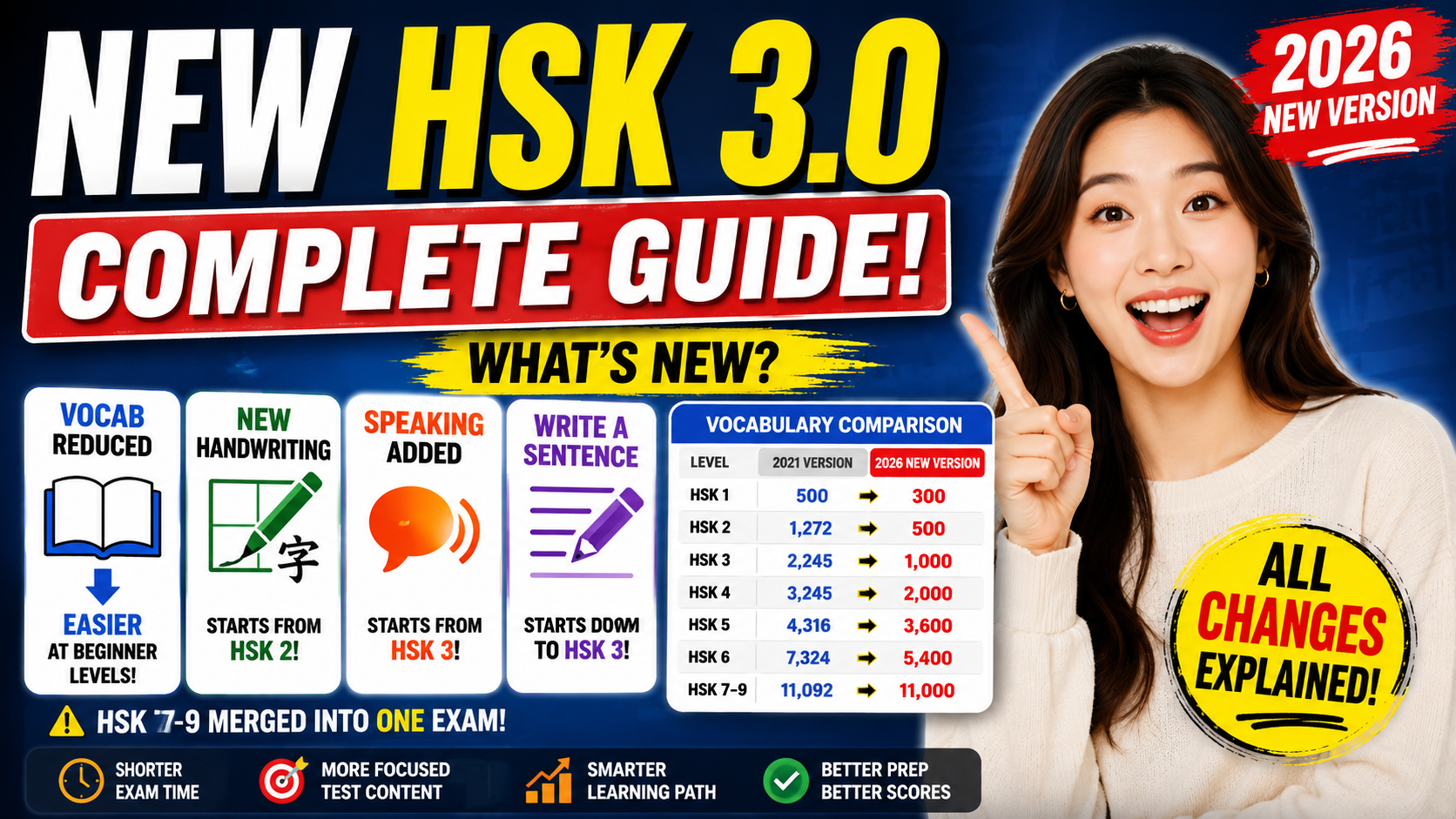
For beginner and intermediate learners, the vocabulary requirements have been significantly reduced. HSK Levels 1–4 now focus on high-frequency core vocabulary instead of requiring thousands of additional words.
At the same time, practical language skills receive much greater attention.
Starting from HSK Level 2, learners begin practicing handwritten Chinese characters.
From HSK Level 3 onward, a speaking examination becomes part of the assessment, encouraging learners to develop real communication skills instead of relying solely on reading and listening.
Writing tasks have also been redesigned. A picture-based sentence-writing exercise that previously appeared at HSK Level 4 has now been moved to HSK Level 3, helping students develop writing ability earlier in their study process.
Finally, the advanced HSK Levels 7, 8, and 9 are combined into one unified examination. Instead of registering for separate tests, candidates take a single advanced exam, and their final score determines whether they achieve HSK Level 7, 8, or 9.
These updates make the overall system more logical, more practical, and more closely aligned with the way people actually learn and use Chinese.
A New Philosophy of Chinese Learning
HSK 3.0 changes both the level system and the way learners should prepare for the exam.
It represents a new philosophy of learning Chinese.
Instead of asking learners to memorize isolated vocabulary lists, the updated framework encourages them to:
- Understand spoken Chinese.
- Read authentic materials.
- Write meaningful sentences.
- Communicate confidently in everyday situations.
- Build practical language skills step by step.
This shift benefits not only students preparing for the HSK examination but also anyone who wants to use Chinese in study, work, or daily life.
As you continue reading, we'll explore each of the official changes in detail, compare the three HSK standards, explain the new exam formats, and provide practical study strategies to help you succeed under the New HSK 3.0 system.
Key Changes in New HSK 3.0 (2026)
HSK 3.0 revises the proficiency framework, but it should not be treated as the format for every 2026 test date. Use the registration notice for your centre to identify If you are taking HSK 2.0 or an announced HSK 3.0 session.
Compared with the previous HSK system, the new version introduces major changes in vocabulary, exam structure, speaking, writing, and overall difficulty distribution.
In this section, we will break down all the most important changes in detail so you can clearly understand what has changed and how it affects your preparation strategy.
1. Vocabulary Comparison Across Three HSK Systems
One of the most important updates is the change in vocabulary requirements.
Below is a comparison between the three major HSK systems:
| Level | HSK 2.0 | HSK 3.0 (2021 Draft) | New HSK 3.0 (2026) |
|---|---|---|---|
| HSK 1 | 150 | 500 | 300 |
| HSK 2 | 300 | 1,272 | 500 |
| HSK 3 | 600 | 2,245 | 1,000 |
| HSK 4 | 1,200 | 3,245 | 2,000 |
| HSK 5 | 2,500 | 4,316 | 3,600 |
| HSK 6 | 5,000 | 7,324 | 5,400 |
| HSK 7–9 | — | 11,092 | 11,000 |
Key Insight:
- Beginner levels (HSK 1–4) are significantly simplified
- Vocabulary is reduced by nearly 50% compared to the 2021 draft
- Focus is shifted to high-frequency core words
- Advanced levels remain challenging but more structured
This means beginners can start learning Chinese more easily than before.
2. Major Structural Changes in New HSK 3.0
The New HSK is not just about vocabulary—it also changes how the exam itself is designed.
Key System Updates
- Formal nationwide implementation date: not yet announced in the official trial notice
- Lower difficulty for HSK 1–4
- Strong focus on practical communication skills
- Speaking exam introduced from HSK 3
- Writing tasks adjusted and moved earlier
- HSK 7–9 merged into one advanced exam
3. Speaking & Writing Changes
Speaking Test (HSK 3+)
Starting from HSK Level 3, all learners must take a speaking test.
Each speaking exam includes 3 parts only:
- Listen and repeat sentences
- Describe pictures
- Answer questions
This is designed to test real communication ability, not memorization.
Writing Changes
One major structural change is:
- "Write sentences based on pictures" — previously HSK 4, now moved down to HSK 3
This means learners start writing earlier, but in a more practical way.
Handwriting Requirement
- Handwriting starts from HSK 2
- HSK 1 + HSK 2 share 100 writing characters
- HSK 1 does NOT require writing test
This encourages early character familiarity.
4. Exam Structure Changes (Overview)
Below is a simplified explanation of how exam structures changed.
HSK 1 Changes
- Slightly adjusted timing
- Listening and reading remain core
- Total duration becomes more balanced
Focus: basic comprehension
HSK 2 Changes
New structure introduces:
- Writing section (new addition)
- More balanced skill testing
- Slightly reduced listening pressure
Focus: basic communication + writing introduction
HSK 3 Changes (Big Upgrade)
Major change:
- Speaking test becomes mandatory (HSKK 3)
- Writing becomes more important
- Listening + reading become more integrated
Focus: real communication ability begins here
HSK 4–6 Changes
- More balanced skill distribution
- Reduced extreme difficulty spikes
- Writing becomes more task-based
- Speaking integrated at each level (HSKK 4–6)
Focus: practical fluency + academic ability
HSK 7–9
- Old multi-level system removed
- Replaced by one unified advanced exam
- Final score determines level (7, 8, or 9)
Focus: expert-level proficiency
5. Practical Study Advice (Very Important)
Based on the New HSK 3.0 system, here are key preparation strategies:
Strategy 1: Choose Your Exam Timing Wisely
- If you plan to take HSK 1-4, choose material for the version named in your registration notice rather than waiting for an assumed launch date.
- If you are preparing for HSK 5+ — You can start preparing immediately using current standards.
Strategy 2: Focus on Core Vocabulary
Do NOT memorize random words.
Instead:
- Focus on high-frequency vocabulary
- Learn words in context
- Practice sentence building early
Strategy 3: Build 4-Skill Balance Early
New HSK tests:
- Listening
- Speaking
- Reading
- Writing
So your study plan should also include all four skills from the beginning.
Strategy 4: Daily Practice System
Recommended daily routine:
- Vocabulary: 20 min
- Listening: 15 min
- Reading: 15 min
- Speaking: 10 min
- Writing: 10 min
Consistency is more important than intensity.
6. Final Recommendation
The New HSK 3.0 is not just a harder exam—it is a more realistic language system.
It rewards learners who can:
- Understand real Chinese
- Speak naturally
- Write simple sentences
- Communicate in daily life
Instead of memorizing thousands of isolated words, you should focus on real communication ability.
Stay Updated
For more updates on New HSK 3.0 (2026), study guides, and practice materials:
- Subscribe to our YouTube channel: @HSKExamNet
- Visit our website: hskexam.net
We will continue updating all HSK materials based on the latest official changes.
New HSK 3.0 (2026) vs Old HSK: What You Should Know
To fully understand the impact of the New HSK system, it is important to compare it with the previous version.
While the old HSK focused heavily on vocabulary memorization, the new system emphasizes real communication ability and balanced skill development.
In other words:
- Old HSK = Test knowledge
- New HSK = Real Chinese ability
This shift makes the exam more practical for students who want to use Chinese in real life, not just pass an exam.
HSK 7–9 Transformation
One of the most significant structural changes is the merging of advanced levels.
Previously:
- HSK 7
- HSK 8
- HSK 9
Now:
These are combined into one unified advanced exam.
Your final score determines your level:
- High score → HSK 9 level
- Mid score → HSK 8 level
- Lower score → HSK 7 level
This makes the system more flexible and more accurate in measuring real proficiency.
CEFR Comparison (Reference Framework)
The New HSK 3.0 also aligns more closely with international language standards such as CEFR:
- HSK 1–2 → A1–A2
- HSK 3–4 → B1–B2
- HSK 5–6 → C1–C2
- HSK 7–9 → Advanced C2+
This helps universities and employers better understand your Chinese level internationally.
Who Should Take the New HSK 3.0?
The New HSK system is suitable for:
- Beginners starting Chinese from zero
- Students planning to study in China
- Professionals working with Chinese companies
- Language learners preparing for long-term fluency
If your goal is real communication ability, this system is designed for you.
Should You Take the Exam Now or Wait?
This is one of the most common questions.
Take the exam NOW if:
- You are already preparing for HSK 1–6
- You want a certificate soon
- You are applying for universities or jobs
Wait for New HSK if:
- You are a beginner (HSK 1–4 level)
- You want a slightly easier vocabulary system
- You are not in a hurry to get certified
The official trial notice does not give a date for full standardisation. Check the Chinese Test Service notices before deciding when to register.
Frequently Asked Questions (FAQ)
What is New HSK 3.0?
HSK 3.0 is a revised proficiency framework currently being introduced through announced sessions. Regular 2026 dates continue to use HSK 2.0 unless the registration notice says otherwise.
Is New HSK harder than the old version?
It depends:
- Beginner levels (HSK 1–4) → easier
- Advanced levels (HSK 5–9) → more structured and realistic
Overall difficulty is more balanced.
Is handwriting required in HSK 3.0?
In the HSK 3.0 materials summarized here, handwriting requirements begin above Level 1. Confirm the exact requirement in the syllabus for your scheduled exam.
Is the speaking test mandatory?
For the January 2026 HSK 3.0 trial, Levels 3-6 are paired with corresponding speaking tests. Check whether the same rule appears in your registration notice.
Can I still use old HSK certificates?
Ask the university, employer, or other receiving institution which certificate version and validity period it accepts.
How many words do I need for HSK 1?
HSK 1 requires 300 vocabulary words under the New HSK 3.0 system.
What is the biggest change in HSK 3.0?
The biggest changes are:
- Reduced beginner vocabulary load
- Introduction of speaking tests
- Earlier writing tasks
- More practical communication focus
- Unified HSK 7–9 exam
Where can I learn more about HSK?
You can follow:
- YouTube: @HSKExamNet
- Website: hskexam.net
Watch the Full Video Lesson
To better understand all the changes visually, watch our complete breakdown:
New HSK 3.0 (2026) Complete Guide: The Biggest Changes in HSK Test History
https://www.youtube.com/watch?v=wQGwobBtitg
This video explains:
- Vocabulary changes
- Exam structure updates
- Speaking & writing changes
- Study strategies
- Real examples
Key Points to Remember
The New HSK 3.0 (2026) is a major reform that reshapes how Chinese is learned and tested.
Instead of focusing on memorization, it emphasizes:
- Real communication
- Practical vocabulary
- Speaking ability
- Balanced skill development
For learners, this means:
- Less memorization stress
- More practical learning
- Better long-term fluency
If you build a consistent study routine and focus on real usage, the new system will actually help you learn Chinese more effectively than before.
Continue Learning
To continue your Chinese study process, explore:
- HSK Level 1 Vocabulary List (300 Words)
- HSK Level 2 Study Guide
- HSK Flashcards
- HSK Practice Tests
- Chinese Grammar Guides
- Listening Practice Videos
Final Message
Learning Chinese is a long study process, but every step matters.
Stay consistent, practice every day, and keep improving little by little.
After reading the detailed HSK 3.0 guide, use the current official documents to confirm the level, vocabulary list, and tested skills that apply to your exam. Keep the document date with your notes so an older draft is not mistaken for the current requirement.
Before relying on the detailed HSK 3.0 guide, check the Chinese Test Service notices and the notice from your test centre. Update your study plan only after those two sources agree on the format you will take.